
7 Reasons Why Communication Plans Fail in Software Teams

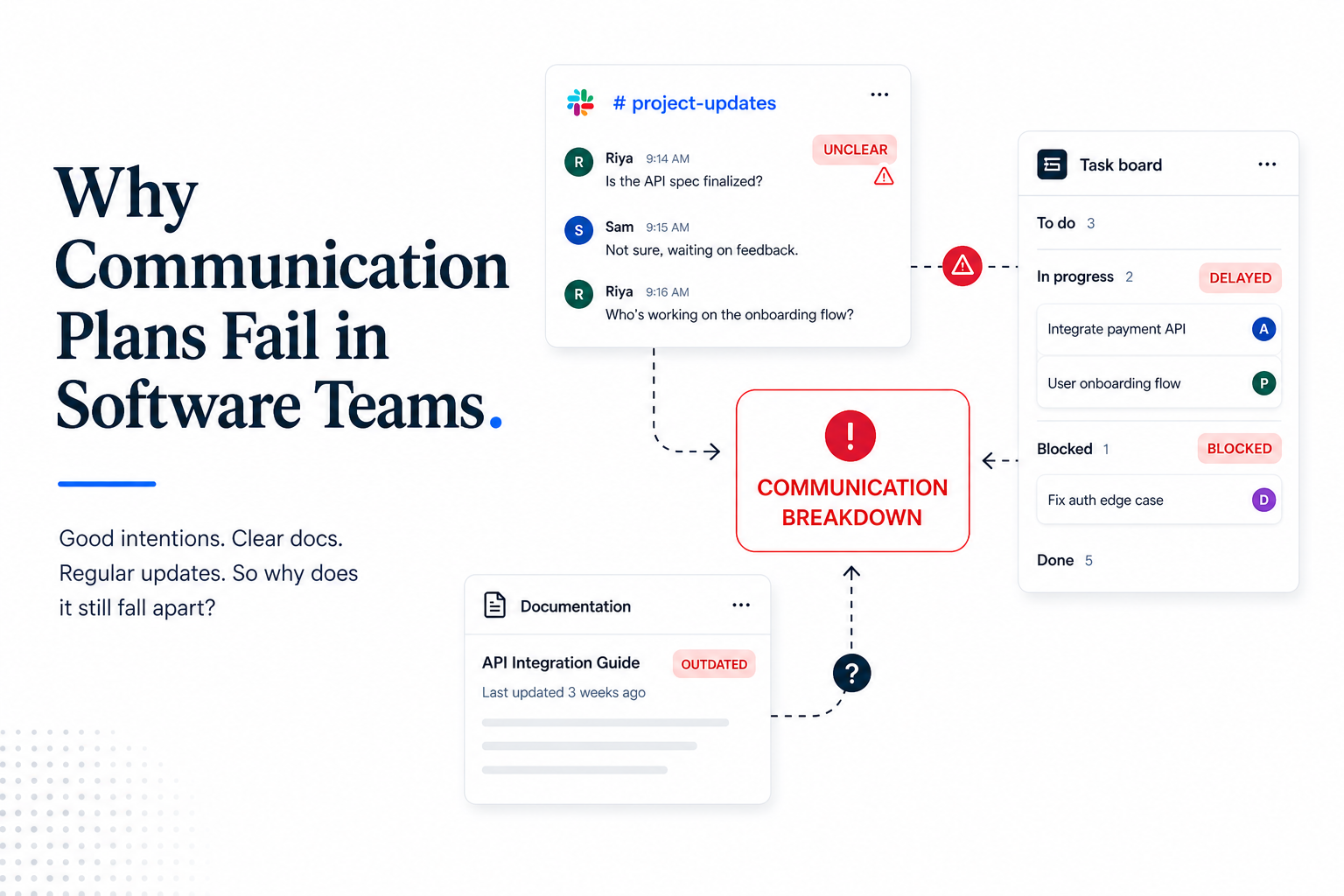
Table of Contents
- The plan describes meetings, not decisions
- Nobody defines what must be written down
- The team never agrees on shared language
- Too many channels destroy accountability
- Stakeholders are informed too late or too vaguely
- One person becomes the communication bridge
- The plan is never tied to delivery moments
- A practical fix
Communication plans fail in software teams not because nobody talks — but because everyone talks in different places, for different reasons, with different assumptions. Understanding why communication plans fail in software teams is the first step toward building a system that survives real delivery pressure.
A communication plan looks great in a kickoff deck. It has channels, meetings, owners, maybe even a RACI table. Then two sprints later, the product manager thinks engineering is aligned, engineering thinks design changed direction, QA discovers a requirement nobody documented, and leadership asks why the release slipped.
The problem is not the existence of communication. The problem is the illusion of alignment. Most communication plans fail in software teams for one simple reason: they are written like governance documents, not operating systems. A real communication plan should reduce ambiguity. In many teams, it does the opposite.
1. The plan describes meetings, not decisions
A weak communication plan says things like: daily standup at 10 AM, weekly stakeholder sync on Tuesday, sprint review every two weeks, and updates shared on Slack. That is not a communication system. That is just a calendar.
The real question is: when something changes, who decides, where is it documented, and how do the affected people know what changed without depending on luck? This is where most teams break. They plan recurring meetings, but they do not define the path of critical information. When communication is meeting-based instead of decision-based, context leaks everywhere.
According to the Project Management Institute, ineffective communication is a primary factor in project failure for one in three projects. The root cause is almost always structural, not interpersonal. Read the PMI report on effective communication and project outcomes.
2. Nobody defines what must be written down
Software teams love speed. But many confuse speed with skipping documentation. Then the same cycle starts: a requirement gets discussed verbally, interpreted differently, partially built, challenged later, and rebuilt under pressure.
Documentation does not need to be heavy. It just needs to exist in the right places. Communication plans fail in software teams most visibly at this point — nobody defines what must be documented, where it lives, who updates it, and when it becomes the source of truth. If you skip that, your team does not have a communication plan. It has a communication mood.
3. The team never agrees on shared language
One of the most dangerous communication problems in software teams is fake agreement. Everyone uses the same words — ready, blocked, urgent, done, MVP, approved — but they do not mean the same thing.
For product, “ready” may mean the requirement is clear enough to start. For engineering, it may mean technically groomed and estimated. For design, it may mean final copy and screens are signed off. For QA, it may mean acceptance criteria are frozen. So the team thinks it is aligned because the vocabulary sounds familiar — but every function is translating the same words differently.
Atlassian’s research on knowledge sharing shows that teams with clearly defined shared terminology experience significantly fewer rework cycles and misalignment incidents during delivery. See Atlassian’s best practices for knowledge sharing in software teams. A serious communication plan defines key terms in the exact language the team uses every week, not abstract definitions nobody reads.
4. Too many channels destroy accountability
Teams often think better communication means more channels: Slack, email, Jira comments, Confluence, WhatsApp, standups, team calls, quick huddles, and Loom videos. The result is not better visibility. It is message fragmentation.
If an incident update goes to Slack, the decision goes into a meeting, the context lives in Confluence, and the task sits in Jira — nobody has the full picture unless they manually reconstruct the story. This is one of the core patterns behind why communication plans fail in software teams: not silence, but channel sprawl that diffuses accountability across too many surfaces.
The fix is simple: assign channel purpose. Slack for fast coordination, Jira for execution status and blockers, Confluence for durable decisions and requirements, meetings for resolving conflict — not broadcasting status. Once every channel has a job, the noise drops fast.
5. Stakeholders are informed too late or too vaguely
A lot of teams delay communication because they want a cleaner update later. That usually backfires. When stakeholders hear about risk too late, trust drops. When engineers hear changing priorities too late, rework grows. When QA hears scope changes too late, coverage weakens.
Communication plans fail in software teams when they treat updates as reputation management instead of risk management. A good plan creates predictable visibility: what changed, why it changed, who is affected, what decision is needed, and what happens next. That structure replaces surprise with clarity and panic with process.
6. One person becomes the communication bridge
The PM knows the business context. The tech lead knows the architecture. The designer knows the user flow. The engineering manager knows the resourcing reality. But instead of building a visible system, the team relies on one strong communicator to keep everything together — until that person is sick, busy, or leaves.
When critical context depends on one person, the team has a communication bottleneck, not a communication plan. This is also a core reason recurring team knowledge keeps getting lost — when knowledge lives in one person’s head, it never makes it into a system the team can rely on.
7. The plan is never tied to delivery moments
The best communication plans are mapped to real moments where failure usually happens. For software teams, those moments are predictable: requirement handoff, scope changes, design approval, sprint commitment, blocker escalation, release readiness, incident response, and postmortem follow-up.
If your communication plan does not define how the team behaves during those moments, it will fail exactly when pressure rises. The real test is not whether a plan exists in Notion — it is whether it survives a messy week. This is precisely why communication plans fail in software teams that look organized on paper but collapse under real delivery conditions.
A practical fix
If you want a communication plan that actually works, make it brutally simple. Use this 5-part structure:
- Event: What happened? Example: scope changed, blocker found, incident opened.
- Owner: Who communicates it? One role, not three.
- Channel: Where is it posted? One primary source, not five.
- Audience: Who must know now? Be specific.
- Decision or action: What happens next? No vague awareness updates.
Communication should trigger action, not just visibility.
Software teams do not need more communication. They need less ambiguity. A bad communication plan creates motion without clarity. A good one creates clarity without extra meetings. If your team is constantly repeating context, rediscovering decisions, or learning important changes too late, the issue is probably not people — it is that your communication plan was built like a document, not a delivery system.
Once your communication structure is solid, the next challenge is execution. Sprint plans built on miscommunication collapse fast — see Why Sprints Collapse After Week Two for the 7 execution mistakes that follow communication breakdown directly into delivery failure.