PRD Automation Is Changing What Product Managers Are Actually Paid For (Part 1: The Problem)

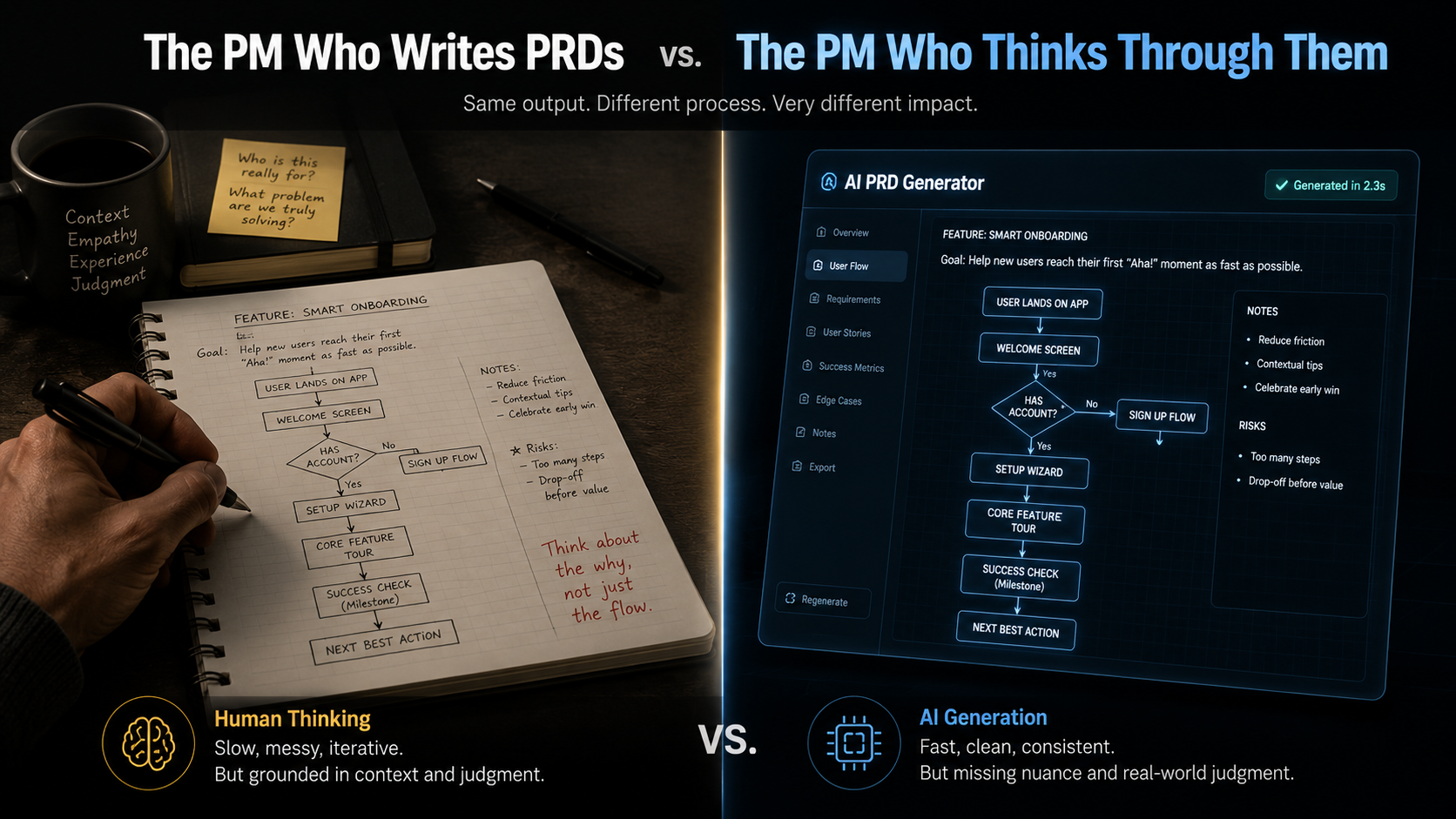
If you became a product manager partly because you were good at writing product requirements documents, you need to understand what PRD automation is doing to that skill — and fast.
This is not a post about whether AI can write a PRD. It can. The more important question is what happens to the PM role when that task stops being a differentiator and starts being a commodity. Part 1 covers the problem: what PRD automation actually does, where it breaks down, and why the PMs most exposed are not the ones you would expect.
What PRD Automation Actually Means for the PM Role
PRD automation refers to using AI tools to generate, structure, or accelerate the production of product requirements documents. That covers a wide range — from a model that fills in a template based on a few bullet points, to a more sophisticated workflow where a PM feeds in user research, competitor notes, and a problem statement, and gets back a full draft with acceptance criteria, edge cases, and open questions flagged.
The tooling has matured quickly. In 2024, AI-assisted PRD drafts were inconsistent enough that most PMs treated them as a starting point at best. By 2026, teams using structured prompting workflows are producing first drafts that are accurate enough to send to engineering for review — not perfect, but complete. According to research published by ProductPlan on product requirements documents, PRDs serve as the central alignment artifact between product, design, and engineering — which makes automating their production a structurally significant shift, not just a productivity upgrade.
The gap between a human-written PRD and an AI-assisted one has narrowed to the point where the difference is no longer primarily about quality. It is about context, judgment, and accountability. That distinction matters for understanding where the threat actually lives.
The PRD Was Never Just a Document
Product managers who understand their role at a structural level already know this. The PRD is a communication artifact, not a deliverable. Its value is not in the document itself — it is in what the writing process forces you to confront: gaps in the problem definition, assumptions that have not been validated, dependencies you have not surfaced yet, and edge cases engineering will ask about in two weeks anyway.
The act of writing a good PRD is a thinking exercise that produces a document as a byproduct. That is what makes PRD automation tricky to evaluate cleanly. When an AI tool produces a structurally complete, well-formatted requirements document in four minutes, it skips the thinking exercise entirely. You get the artifact without the process. For an experienced PM who already did the thinking before sitting down to write, that is a time-saver. For a PM who was using the writing process to do the thinking, it is a trap.
This is the first structural problem PRD automation exposes — not in the tool, but in the PM using it.
Where the PRD Automation Risk Is Concentrated
The PMs most at risk from PRD automation are not junior PMs who write weak documents. They are the mid-level PMs who have built their professional identity around producing polished documentation — and who have not separately developed the skills that documentation was always supposed to serve.
Consider the difference between two PMs:
| PM Type | Core Identity | Exposure to PRD Automation |
|---|---|---|
| Document-centric PM | Produces well-structured, thorough PRDs — this is how they demonstrate value | High. The output is now replicable by any PM with a decent prompt |
| Decision-centric PM | Makes fast, well-reasoned product decisions — documentation captures those decisions | Low. The judgment behind the document is not replicable |
The document-centric PM is not lazy or incompetent. They have often built genuine expertise in structuring requirements clearly, coordinating across stakeholders, and producing documentation that engineering teams trust. The problem is that AI can now replicate the output of that expertise without replicating the expertise itself — and organizations are starting to notice the difference in hiring, promotion, and team design decisions.
What AI-Generated PRDs Get Wrong (And Why That Is Still a Problem)
AI-generated PRDs fail in predictable ways, and none of them are about grammar or formatting. The failures are structural and contextual:
- They hallucinate confidence. An AI draft presents assumptions as decisions. A section that should contain open questions gets filled with plausible-sounding answers that have never been validated. Teams downstream do not always know which parts were researched and which were generated.
- They miss organizational context. A PRD is not just a product artifact — it is a political document. It reflects which stakeholders were consulted, which constraints were accepted, and which trade-offs were made deliberately. AI tools do not understand your organization’s history, your engineering team’s current capacity, or why the last three attempts at a similar feature failed.
- They flatten ambiguity. Good product thinking preserves productive ambiguity — the space where the team can still make better decisions as they learn more. AI-generated PRDs tend to resolve ambiguity prematurely, producing documents that look definitive but are actually fragile.
- They do not carry accountability. A PRD written by a PM is a professional commitment. When that PM is in the room when things go wrong, the document reflects their judgment. An AI draft has no author in any meaningful sense — which creates real problems for teams that use PRDs to coordinate accountability across product, design, and engineering.
These are genuine weaknesses. But they do not make PRD automation irrelevant — they define the conditions under which it fails. A PM who understands those conditions can use the tool responsibly. A PM who does not will produce documents that look complete and fall apart in implementation.
The PM Skills PRD Automation Cannot Replace
The capabilities that PRD automation cannot replicate are not writing skills. They are upstream of writing:
- Problem definition. Before any document gets written, someone has to decide what problem is worth solving and why. That decision involves user research, business strategy, competitive context, and organizational priorities. AI tools can summarize inputs, but they cannot make the call.
- Scope judgment under pressure. The most important PRD decisions are the ones about what not to include. That judgment requires understanding engineering capacity, business urgency, user behavior, and organizational risk tolerance simultaneously. It is contextual in a way that resists automation.
- Stakeholder translation. A PRD has to work for engineering, design, business, and sometimes customers. Each of those audiences needs something different from the document. A PM who understands each stakeholder’s actual concerns — not just their stated preferences — writes requirements that pre-empt the questions that would otherwise derail the next four meetings.
- Validation before documentation. The most dangerous PRD automation failure mode is using AI to write requirements for assumptions that have not been validated. The tool does not know what has been tested. The PM does — or should.
None of these capabilities appear in the document itself. They are the invisible upstream work that makes a PRD credible. PRD automation compresses the documentation phase. It does not replace the thinking phase — it just makes it more visible when a PM skipped it.
Who Is Actually at Risk From PRD Automation
The clearest signal of exposure is this: if removing the act of writing a PRD from your workflow would make it harder to demonstrate your value to your team, you are more exposed than you realize.
That is not a comfortable test to run. But it is the right one. Teams that are adopting PRD automation effectively are not using it to produce the same PRDs faster. They are using it to shift PM time toward the decisions that documentation was always supposed to capture — and away from the production work that AI now handles.
In those teams, PMs who bring strong problem definition, sharp scope judgment, and credible stakeholder alignment are accelerating. The documentation becomes faster and less central. The judgment behind it becomes more visible and more differentiating.
PMs who have been measured primarily on documentation throughput — number of specs shipped, clarity of acceptance criteria, consistency of formatting — are finding that the bar has moved. The tooling that used to be the ceiling is now the floor. Organizations have less patience for PMs who treat documentation as the work rather than as evidence of the work.
The Real Shift Behind PRD Automation
PRD automation does not replace product managers. It accelerates a shift that has been underway for several years — the shift from PMs as documentation producers to PMs as decision-makers who document their decisions clearly.
The problem is that the PM community has not always made that distinction visible. Hiring rubrics, performance reviews, and PM portfolios have historically leaned heavily on documentation quality as a proxy for product quality. That proxy is now broken. You can produce a well-structured PRD in four minutes with the right prompt. What you cannot prompt your way to is the judgment about whether you are solving the right problem, the stakeholder trust that makes the document credible, or the organizational context that determines what the requirements actually need to say.
Part 2 of this series covers the practical response: what the shift means for how PMs should position themselves, which AI tools are actually useful in a mature PRD workflow, and what a responsible PRD automation process looks like when it is working well.
For now, the diagnostic is straightforward: audit your last five PRDs. How much of the value you delivered lived in the document — and how much lived in the decisions and conversations that preceded it? The answer tells you more about your exposure than any job listing will.
If you want to understand the AI workflow changes affecting product managers more broadly, the post on AI for product managers and weekly workload reduction covers the overhead layer in detail. For the broader question of how software teams are evaluating and adopting AI tools without getting burned, this framework for evaluating AI tools without falling for marketing hype is the right starting point.