PM Judgment Skills: 6 Capabilities That Outlast PRD Automation

Part 1 of this series established the diagnosis: PRD automation has turned a polished requirements document from a professional differentiator into a commodity any PM with a decent prompt can produce. That left an open question this post answers directly. If writing the document no longer proves anything, what does a PM actually need to get better at? The answer is a specific, learnable set of PM judgment skills — and the data on how PM hiring and performance are shifting in 2026 backs up why these particular six matter more than the rest.
This is not a tools list. Plenty of posts already cover which AI assistant drafts the cleanest first pass at a requirements doc — that ground is covered in 5 Best AI Tools for Writing PRDs. The harder, more useful question is what a PM should be deliberately practicing once that first draft takes minutes instead of days — because building PM judgment skills determines whether the freed-up time makes a PM more valuable or just busier in the same low-differentiation lane.
Why PM Judgment Skills Are Replacing Documentation as the Hiring Signal
For years, a thorough, well-organized PRD was a reasonable proxy for product thinking. It was hard to fake, because writing one forced a PM to confront gaps in the problem definition before anyone read a word. That proxy has broken. According to Product School’s research on PM skills for 2026, the qualities now separating strong hires are product sense under ambiguity, execution honesty, and strategic judgment when the data is incomplete — none of which show up in a finished document, all of which show up in how a PM behaves before that document exists.
The shift shows up in performance data too. Teams that lean on intuition alone, without a disciplined judgment process behind it, see roughly 50% more failed initiatives, while the PMs getting the best outcomes combine quantitative signal with a deliberate decision process rather than either one alone.
That distinction — process and judgment, not raw output — is exactly what PM judgment skills are meant to capture, and exactly what a fast AI draft cannot supply on its own. The same research notes that 92% of PMs expected to succeed through 2026 will lean on a mix of quantitative and qualitative analysis just to decide what to prioritize, which is a judgment exercise, not a documentation exercise. Building PM judgment skills, in other words, is what that prioritization work actually requires.
The 6 PM Judgment Skills Worth Building Deliberately
These PM judgment skills overlap, but each one fails independently — a PM can be strong at one and still get exposed by a gap in another. Treat them as six separate muscles, not one general aptitude.
None of these PM judgment skills are new ideas. What changed is their weight. When a thorough document was expensive to produce, being good at producing one carried value by itself. Now that production is cheap, these six capabilities are what actually separates a PM who becomes more essential from one who becomes interchangeable.
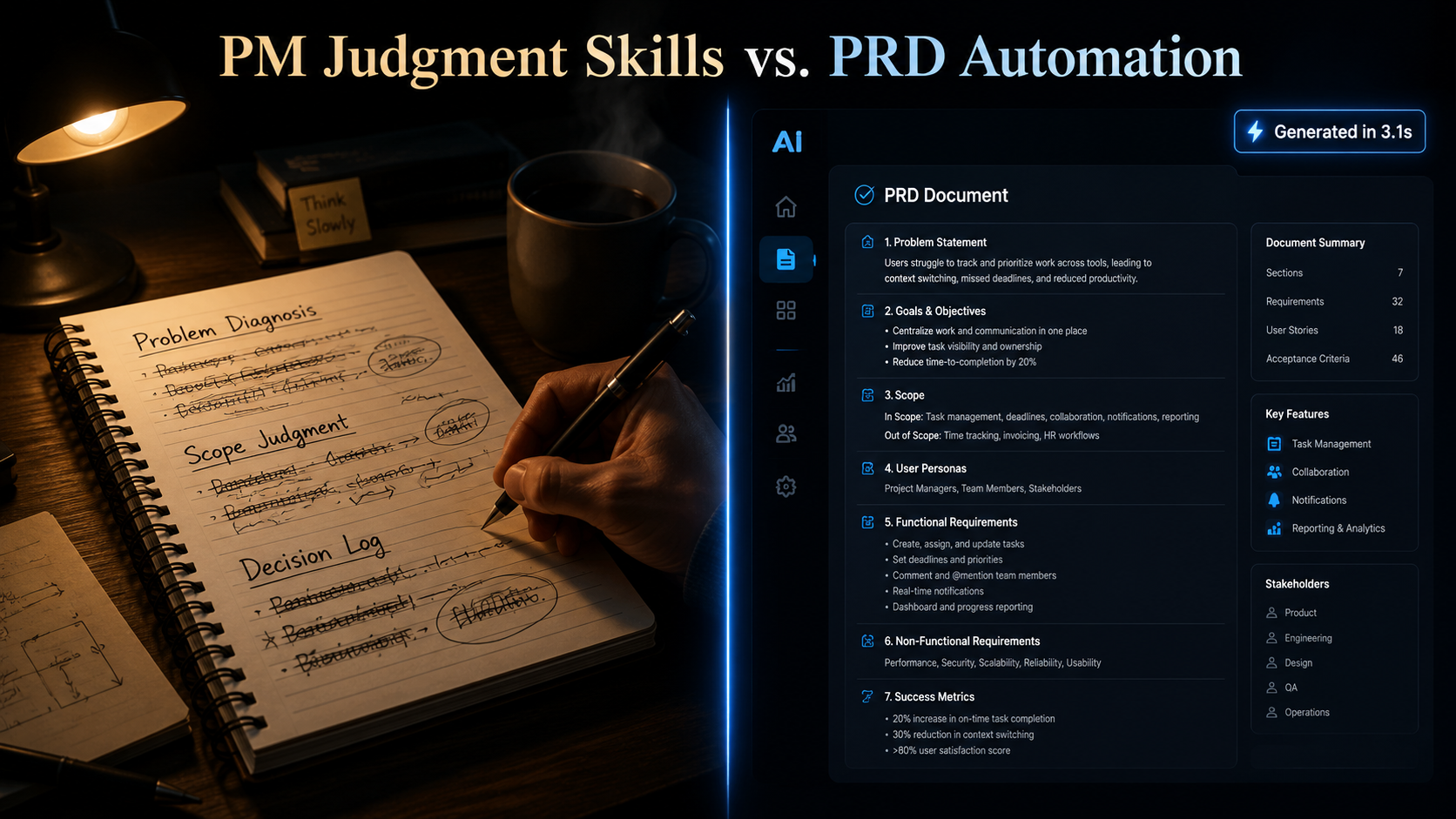
1. Problem Diagnosis Before Anyone Drafts a Solution
Before a single requirement gets written, someone has to decide a problem is worth solving this quarter instead of three other problems competing for the same engineering time — and defend that call when a stakeholder wanted something else. AI tools can summarize a pile of support tickets or interview transcripts in seconds.
They cannot tell you which problem is strategically worth the team’s next six weeks. That call sits entirely with the PM, and it is the first PM judgment skill that AI adoption makes more visible, not less important.
This skill shows up earliest in a project’s life, usually before any backlog ticket exists. A PM with strong problem diagnosis can sit in a room with five plausible feature requests and explain, in two minutes, why one of them is structurally more important than the other four — not because it’s louder, but because of what it unblocks downstream. That explanation is the actual deliverable. The ticket that eventually gets written is just a record of a decision that already happened.
2. Scope Judgment Under Real Constraints
Scope judgment is one of the harder PM judgment skills to demonstrate without a document to point to. A complete-looking PRD used to be indirect proof that someone had scoped carefully. Now that a competent-looking draft takes four minutes, scope judgment has to be demonstrated separately, out loud, before the document exists. That means being able to say “we are explicitly not building this for the next release, and here is the cost if we tried” — and having the statement hold up when an executive pushes back in the room.
This is much harder to fake than a clean document, which is exactly why scope judgment carries more weight now than it did three years ago. A PM who can defend a scoping call in real time, without a finished document to point to, is demonstrating the actual skill instead of its old paper trail.
3. Stakeholder Translation That Pre-Empts Objections
Stakeholder translation is one of the PM judgment skills that rarely gets credit because it’s invisible when done well. A requirement that satisfies engineering, design, and finance at the same time is not a writing accomplishment. It reflects understanding what each group actually cares about — not what they say in a status meeting, but what will make them push back two weeks later.
PMs who build this skill produce specs that survive review on the first pass. PMs who skip it produce specs that look finished and unravel across four follow-up meetings, no matter how polished the AI-assisted draft looked going in.
The translation work is rarely about vocabulary. Engineering, design, and finance usually understand each other’s words just fine. The friction comes from each group optimizing for a different failure mode — engineering worried about maintainability, design worried about a broken experience, finance worried about a cost nobody flagged. A PM who has internalized each group’s actual worry, not their stated preference, writes a single requirement that quietly answers all three concerns before anyone has to ask.
4. Validation Discipline Before Documentation
Validation discipline is the quietest of the six PM judgment skills, but it’s the one that prevents the most expensive mistakes. The most dangerous habit AI enables is writing confident-sounding requirements for assumptions nobody has actually tested. A PM with strong validation discipline treats every requirement as provisional until it has been checked against real user behavior, current system behavior, or a stakeholder with direct authority over the answer.
This discipline is trainable, not innate — which means it is one of the PM judgment skills a PM can practice deliberately on every requirement, not a trait some PMs simply have and others don’t.
5. Editing AI Output for What It Got Wrong, Not What Sounds Right
Of all the PM judgment skills, this is the one AI adoption rewards fastest and punishes hardest for skipping. Reading an AI-generated draft and accepting the parts that sound plausible is not a skill. Catching where it quietly resolved ambiguity it should have flagged, invented a constraint that doesn’t exist, or missed an edge case specific to your system — that is the skill. It is closer to a senior editor’s instinct than a junior PM’s checklist, and it is the fastest of the six PM judgment skills to build deliberately, because every AI-assisted draft is a practice rep if a PM treats it that way instead of rubber-stamping it.
A practical way to build this fast: before accepting any AI-generated requirements draft, force yourself to find at least one thing wrong with it before reading it a second time. There is almost always something — a resolved ambiguity that should have stayed open, a missing edge case, a constraint stated as fact when it was actually a guess. Doing this consistently, on every draft, turns editing into a trained reflex instead of an occasional gut check.
6. Decision Documentation Instead of Requirements Documentation
This is the structural shift underneath all five other PM judgment skills: writing down the decision and its reasoning, with the requirements as a byproduct, instead of writing the requirements and hoping the reasoning is implied somewhere. A decision log that says “we chose this over the alternative because of this constraint, and we’ll revisit if that changes” survives organizational memory loss in a way a clean PRD never could.
It is also far harder for AI to generate convincingly, because building decision documentation requires an actual stance, not just a plausible structure.
What This Looks Like Inside a Real Sprint
Here is what applying these PM judgment skills actually looks like across one sprint, rather than in the abstract. Consider a PM who used to spend two full days drafting requirements for a permissions change touching three teams. Under the old model, value was visible in the thoroughness of the resulting document — every edge case named, every stakeholder’s concern addressed in writing, nothing left ambiguous on the page.
Under a judgment-first approach, the same PM spends roughly ninety minutes getting an AI-assisted first draft built from a baseline spec of how the system actually behaves today, the way a structured Claude-assisted requirements workflow handles it. The two days that used to go into drafting and formatting go somewhere else instead.
That freed-up time goes to a short call with the finance stakeholder to confirm an assumption the draft surfaced as unverified, a scoping conversation with engineering about what genuinely ships this release versus what gets deferred, and a brief written decision log explaining why the team chose a phased rollout over a single release.
The resulting requirements document looks fairly similar to the old two-day version. The work behind it is completely different — applying PM judgment skills at every step — and considerably more defensible if something goes wrong six weeks later.
PM Judgment Skills vs. Documentation Throughput: A Direct Comparison
| What’s Measured | Documentation-Throughput Model | PM Judgment Skills Model |
|---|---|---|
| Primary output | Number and polish of requirements documents shipped | Quality and traceability of decisions made |
| Where time goes after a fast AI draft | Producing more documents, faster | Validation, stakeholder alignment, decision records |
| What gets reviewed in a performance conversation | The document itself | Why a call was made and what it cost to get there |
| Exposure to AI substitution | High — the artifact is now cheap to replicate | Low — the judgment behind the artifact isn’t replicable by a prompt |
The comparison is not subtle once it’s laid out. A PM optimizing for the left column is competing with a tool that gets better every quarter. A PM optimizing for the right column is competing on PM judgment skills that don’t commoditize the same way.
How to Build These Skills Without a Formal Program
None of the six PM judgment skills above require a training course or a new title. They require deliberately redirecting the time that drafting used to consume, starting with the next requirement on your list.
- Pick one feature with real cross-team complexity rather than trying this on something trivial where judgment barely matters.
- Use AI to handle the baseline extraction and first-draft requirements — the mechanical part of the work that doesn’t build judgment regardless of how long it takes manually.
- Spend the saved time on the riskiest assumption in the draft, confirming it with whoever actually has the answer before a document anchors the conversation.
- Hold the stakeholder conversation earlier than you normally would, before anyone has seen a polished version to react to instead of interrogate.
- Write a short decision log, two or three sentences, explaining the choice made and the alternative rejected.
Track what changes over the next two releases. The requirements documents will likely look similar to what came before. What should change is how often a decision gets revisited weeks later because nobody remembers, or can find, the reasoning behind it — and that single difference is the clearest signal these PM judgment skills are actually developing instead of staying theoretical.
How Performance Reviews Need to Change to Measure This
Most PM performance frameworks still score what is easiest to count: number of PRDs shipped, sprint velocity influenced, features launched on schedule. None of those metrics distinguish a PM who made a defensible call under uncertainty from one who got lucky, or one who avoided a hard decision by deferring it to someone else.
If a team wants PM judgment skills to actually improve, the review process has to start asking different questions. A more useful review looks at the decision log directly: how many calls did this PM make under genuine ambiguity, how often did they revisit a decision when new information arrived instead of defending the original choice out of ego, and how often did a stakeholder conversation happen before a document existed rather than after one was already circulating for sign-off.
None of these show up in a velocity chart. All of them are visible if a manager is willing to read the reasoning trail instead of just the shipped output, which is the same shift this entire piece has been describing, just applied to how PMs themselves get evaluated on their judgment skills rather than how they work day to day.
This also changes what good coaching looks like. A manager who only reviews finished PRDs is coaching the wrong layer — by the time the document exists, most of the judgment work already happened, unobserved. Coaching that happens earlier, during the scoping conversation or the stakeholder negotiation, catches the actual skill in motion and gives a PM something to adjust in real time instead of a retrospective note on a document that’s already final.
Where Junior PMs Fit Into This Shift
Building PM judgment skills early matters even more for people without a long track record to fall back on. Early-career PMs face a specific version of this problem. Historically, writing a thorough, well-organized PRD was one of the fastest ways to build credibility before having the track record to be trusted with bigger calls. That path has narrowed, because the artifact that used to prove diligence is now cheap to produce regardless of who is behind it.
The replacement path is less tidy but still learnable: sit in on the messy upstream conversations even before being the one making the call, and pay attention to which assumptions experienced PMs choose to validate versus which ones they leave deliberately provisional.
Volunteering to write the decision log after a contentious meeting teaches the skill of extracting the actual reasoning from a room full of people who each remember the discussion slightly differently. None of this produces a polished deliverable the way a PRD does — which is precisely why building these PM judgment skills early gives a junior PM a capability AI cannot quietly replicate on their behalf.
It is worth saying directly: this is a harder, slower way to build credibility than producing visibly thorough documents used to be. None of the six PM judgment skills come with a checklist that proves you have them on a given Tuesday.
They show up in how a PM behaves under pressure, across many small decisions, which is exactly why they take longer to build and longer to fake. A junior PM who understands this early, and who studies how stronger PMs handle ambiguity rather than only how they format a document, closes that gap faster than one waiting for a formal training program to teach it.
Common Mistakes That Stall the Shift
A few habits consistently prevent PMs from actually building these PM judgment skills, even when the intention is there. Watch for these specifically, since each one looks like progress while actually blocking it.
- Treating AI time savings as personal time, not reinvested time. If the hours saved on drafting don’t go toward validation or stakeholder work, the shift never happens — the PM just produces the same low-differentiation output faster.
- Accepting AI-generated confidence without checking it. A draft that reads fluently is not the same as a draft that’s correct. Skipping the editing-for-errors skill means specs ship with invented constraints baked in, discovered downstream instead of caught upstream.
- Skipping the decision log because the requirements doc feels sufficient. The requirements doc says what to build. It rarely says why this approach and not the alternative — which is the part that protects a PM’s credibility months later.
- Measuring personal output by documents shipped instead of decisions made. This metric was already outdated before AI entered the picture; AI just makes the mismatch impossible to ignore.
The Practical Next Step
None of the six PM judgment skills above demand a new tool stack or a multi-quarter transformation plan. They require a decision about the next requirement on the list: write it the old way, treating the document as the deliverable, or write it the new way, treating the document as evidence of decisions that can actually be defended later.
The second version takes the same amount of calendar time. It just spends that time on the part of the job that’s still entirely the PM’s to own — the same PM judgment skills that separate a PM who gets more essential from one who gets replaced, covered in more depth in Part 1 of this series, which lays out exactly why that ownership is shrinking for PMs who don’t make this shift. The tools guide can speed up the draft. Building the PM judgment skills behind it is the part no tool can do for you.
If documentation speed was never really the bottleneck, the next requirements doc is the right place to find out what was.