3 AI Handoff Mistakes That Break PM Workflows (And How to Fix Them)

Most conversations about AI in PM work focus on the wrong failure point. They ask whether the tool chose the right words, whether the summary was accurate, whether the risk log was complete. Those questions matter — but they miss where things actually fall apart.
AI handoff mistakes are the quiet killers in software team workflows. Not the bad prompts. Not the hallucinated content. The moment a well-generated AI output leaves the context it was created in and enters someone else’s hands without explanation — that is when the noise begins. Understanding where AI handoff mistakes happen is more valuable than optimizing the prompt that created the output in the first place.
The Moment AI Fails Your Team
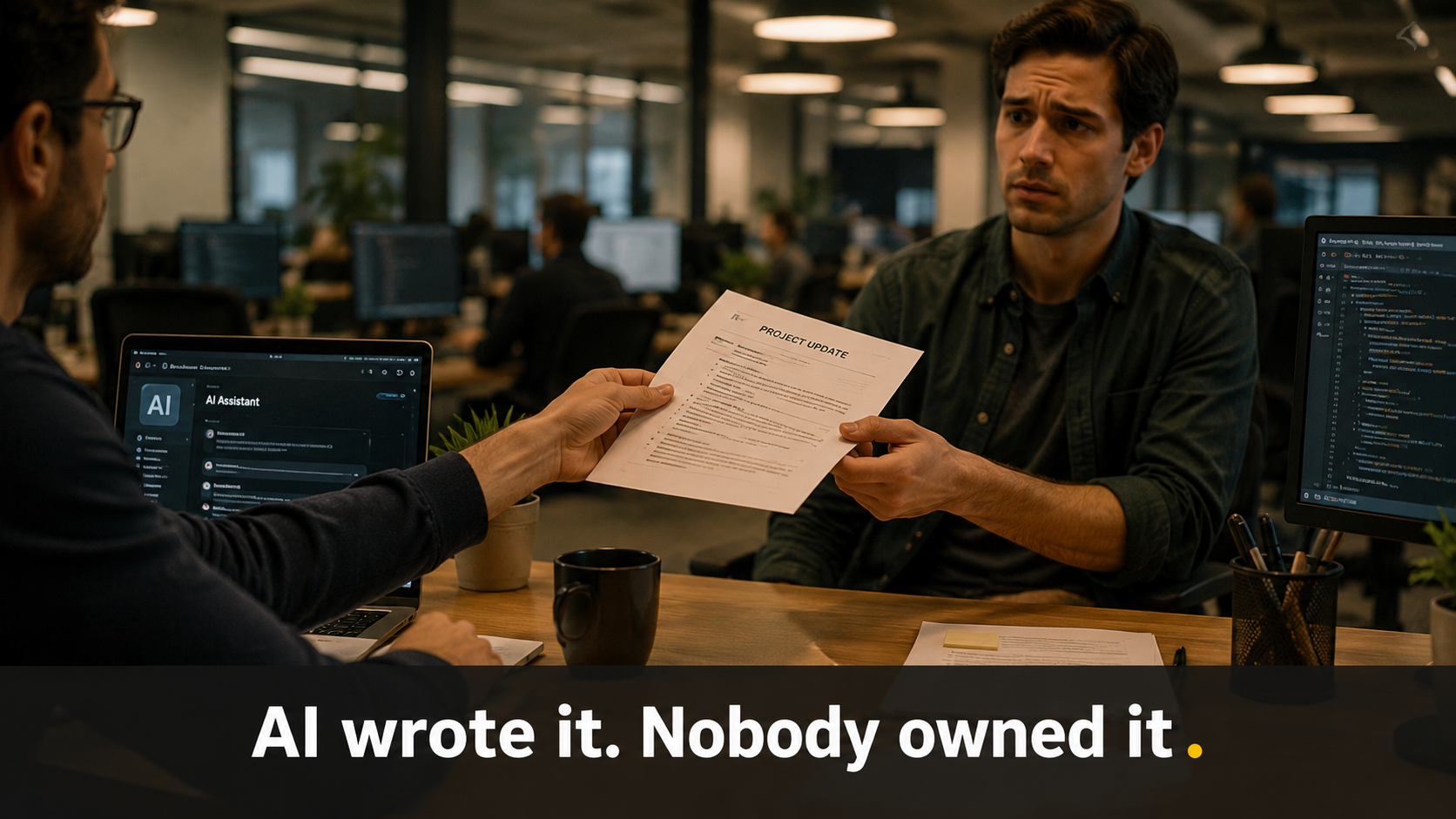
There is a specific failure pattern that shows up across software teams using AI for project communication. A PM drafts a status update using an AI tool. It is clear, well-structured, and covers the main points. They send it to the team. The team forwards it to a stakeholder. The stakeholder flags a risk that was already resolved two days ago. A thirty-minute clarification call follows.
The AI did not fail. The handoff did.
This is not a tool problem. It is a context-transfer problem. And it is one of the most consistent ways that AI creates more work instead of less for PMs who adopt it without thinking through the distribution chain. AI handoff mistakes like this one are preventable — but only once you know where to look for them.
What an AI Handoff Actually Looks Like
An AI handoff happens any time output generated with AI assistance is passed to someone who had no part in creating or reviewing it. This includes:
- Status updates drafted by AI and sent directly to stakeholders without PM review
- Meeting summaries generated from transcript tools and forwarded without editing
- Risk flags produced by AI analysis tools and included in reports without qualification
- Sprint retrospective outputs used as input in the next planning cycle without human interpretation
Each of these scenarios has one thing in common: the person receiving the output does not know what it is based on, what was left out, or whether it reflects the current state of reality.
The Three AI Handoff Mistakes That Damage PM Workflows
Mistake 1: The Summary Without the Decision
AI is very good at summarizing what was said. It is not good at capturing why a decision was made, what alternatives were rejected, or what the mood in the room was when the call ended. When a meeting summary generated by AI gets forwarded to someone who was not on the call, they receive the surface without the depth. That leads to either wrong assumptions or follow-up questions that the PM then has to answer manually — the opposite of the efficiency the tool was supposed to provide. This is one of the most common AI handoff mistakes in day-to-day PM communication.
Mistake 2: The Risk Flag That Sounds Generic
AI-generated risk logs tend to flag the kinds of risks that should be flagged in any software project: scope creep, resource constraints, unclear requirements. When those flags land in front of a stakeholder without context about which ones are active versus theoretical, which are being tracked versus already mitigated, the entire risk log loses credibility. This is one of the reasons AI for stakeholder management requires careful framing — a flag without an owner and a status is just background noise.
Mistake 3: The Update That Is Already Outdated
AI drafts fast. Teams move fast. By the time a status update drafted at 9am gets reviewed, approved, forwarded, and read, it may reflect a reality that no longer exists. This is especially common in sprint handoff moments. When AI-generated sprint summaries from one cycle are fed into the next cycle’s planning without human interpretation, the team ends up building on a version of events that has already been revised in conversation — but not on paper. Catching this category of AI handoff mistakes requires a simple habit: never send without a timestamp check.
AI Handoff Mistakes: Output Used Well vs. Handed Off Without Context
| Scenario | AI Output Used Well | Handed Off Without Context |
|---|---|---|
| Status Update | PM reviews AI draft, adds current blockers and scope changes, confirms accuracy before sending | PM sends AI draft directly to stakeholder distribution list without review |
| Meeting Summary | PM annotates key decisions, marks action owners, removes outdated items before forwarding | Auto-generated transcript summary forwarded as official meeting notes without editing |
| Risk Flag | PM reviews flags, adds status (active / resolved / monitored), assigns owners in the report | AI-generated risk log attached to project report without qualification or context |
| Sprint Handoff | Summary reviewed, human interpretation and current context added for next cycle planning | Previous sprint AI summary used directly as planning input without PM interpretation |
| Stakeholder Report | AI draft reviewed against latest data, framing adjusted for the specific audience | AI-generated report sent as final version without audience-specific editing or framing |
The right-hand column is where AI handoff mistakes live. None of those scenarios required a better AI tool. They required a PM who stayed in the loop between generation and distribution.
Why Generic AI Output Gets Ignored
There is a pattern that experienced stakeholders recognize quickly: AI-formatted communication sounds a certain way. It uses consistent structure, neutral language, and covers expected topics. When that pattern becomes associated with low-information content — summaries that do not tell you anything new, updates that could have been written about any project — people stop reading carefully.
This is a trust problem that compounds over time. The first few AI-assisted updates might get full attention. After several cycles of generic, unhelpful output, stakeholders learn to skim or ignore entirely. Understanding why communication plans collapse in software teams often comes back to exactly this erosion of signal quality over time. Most AI handoff mistakes are not visible in the draft — they surface when the wrong person reads it in the wrong context.
For more on diagnosing this kind of drift before it becomes a habit, the AI misuse audit checklist is a practical starting point.
How to Avoid AI Handoff Mistakes Before You Distribute
Three practices that change the outcome without adding significant time:
Add the context layer before you distribute. Every AI-generated output that will leave your hands should have one sentence of human-added context: what changed since the last update, what this summary does not cover, or what the recipient should focus on. Thirty seconds of annotation prevents thirty minutes of back-and-forth.
Match the output to the audience before forwarding. AI generates for a generic recipient. Your stakeholders are not generic. A risk summary for a technical lead needs different framing than the same summary for a product sponsor. Review the output through the lens of the specific reader before it leaves your inbox.
Own the output, even if you did not write every word. AI-assisted does not mean unreviewed. When your name is on a communication, you are accountable for its accuracy and appropriateness, regardless of how it was drafted. That accountability is the check that prevents AI handoff mistakes from compounding across sprints and stakeholder cycles.
The Real Rule for AI in PM Workflows
AI is a drafting tool, not a distribution tool. The moment you start treating AI output as ready-to-send rather than ready-to-review, you have transferred responsibility to a system that cannot hold it. That is where the noise in your workflow comes from — not the tool, but the misplaced trust in what the tool produces at the moment of handoff.
McKinsey’s research on where AI creates value in organizations consistently points to the same gap: AI performs well in structured generation tasks and falls short when outputs require judgment, context, and audience awareness. That gap is exactly where human PM expertise should live.
One Practical Next Step
Before your next sprint handoff, take one AI-generated output — a status update, a risk summary, a meeting recap — and add three things before you send it: the one thing that changed since the last update, the one item the recipient should prioritize, and the one thing the AI summary does not capture. That annotation takes two minutes. It is the difference between a handoff that builds trust and one that creates more questions. These AI handoff mistakes are preventable — but only if you stay in the chain between generation and distribution.
Further reading: HBR on using AI as a thought partner rather than a source of truth | PMI on AI and evolving PM skills