AI for Stakeholder Management: 5 Proven Ways Smart PMs Prevent Escalations

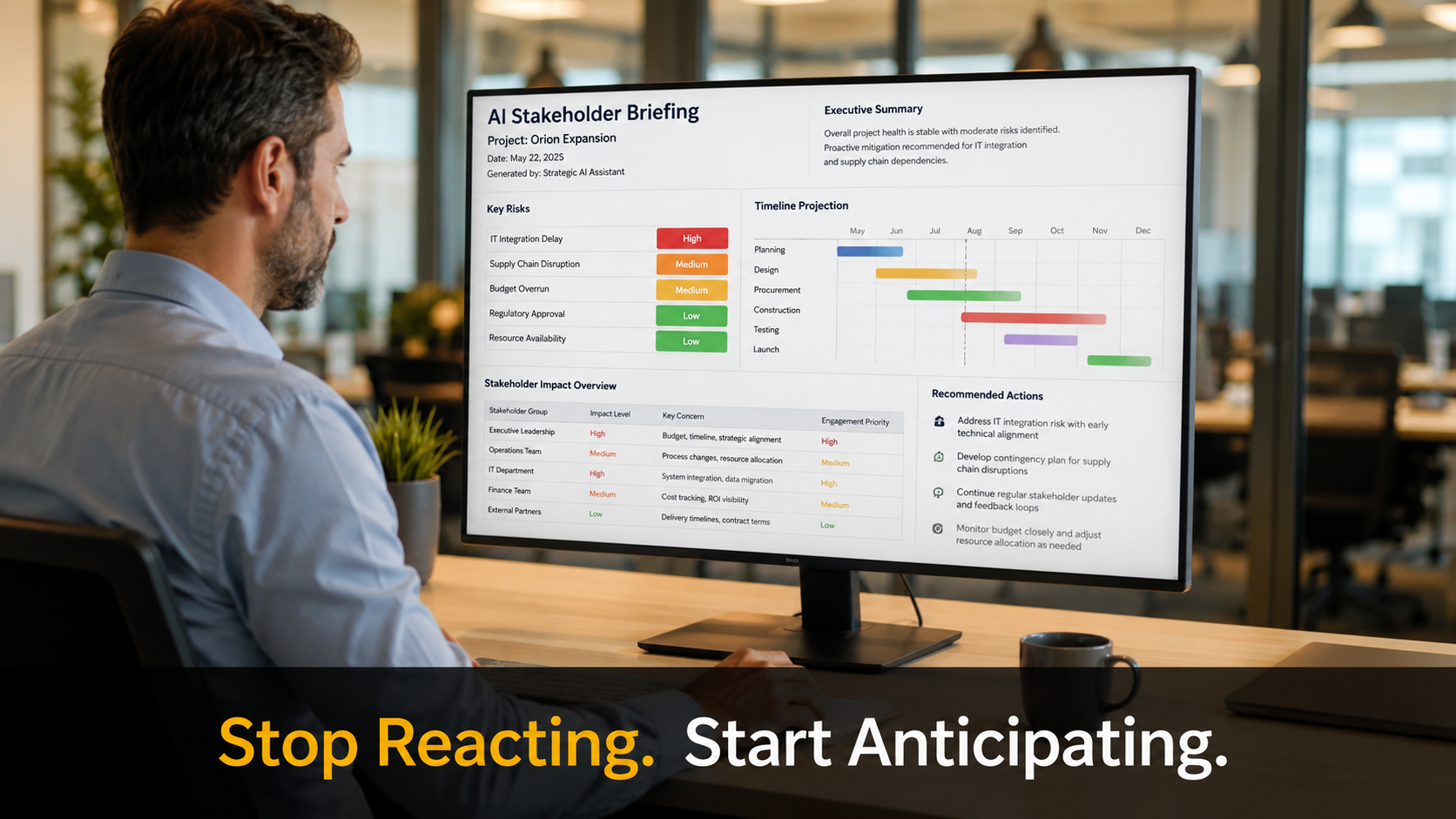
Table of Contents
- The real problem is not the update — it is the surprise
- Why reactive reporting is a trust problem, not a time problem
- What proactive stakeholder alignment actually looks like
- 5 proven ways AI for stakeholder management helps PMs anticipate concerns
- Using AI to model scenarios and frame delivery context
- Where CustomGPT.ai fits in a stakeholder communication workflow
- What AI should not do in stakeholder management
- A practical approach to shift from reactive to proactive
Every PM has been there. The sprint is off track, a dependency slipped, or scope quietly expanded — and the first signal is not from your team. It is a message from a VP asking why they were not told sooner.
That is not an update problem. It is an alignment problem. And it happens because most project managers are trained to communicate after something is certain — not before something becomes a concern.
AI for stakeholder management changes this dynamic entirely. Not by writing faster emails, but by helping PMs see around corners: anticipating the questions stakeholders will ask before they ask them, modeling the scenarios worth communicating before they become headlines, and framing delivery context before it triggers doubt. When applied correctly, AI for stakeholder management shifts the PM’s role from reactive reporter to proactive strategist.
The Real Problem Is Not the Update — It Is the Surprise
There is a reason experienced stakeholders rate PMs not by how well they report, but by how rarely they are surprised. A clean status update delivered two weeks too late is not communication — it is documentation of a failure.
The structural tension is real: PMs work closest to execution noise, while stakeholders operate furthest from it. The bigger the distance between those two layers, the more distortion accumulates. By the time a risk becomes a blocker and a blocker becomes a delay, the PM has been managing it for days. The stakeholder hears about it in a meeting.
This is the trust gap that reactive reporting creates. Consistent surprises, even well-documented ones, erode stakeholder confidence faster than any individual delivery failure. This is precisely why AI for stakeholder management has become a critical competency — not as a reporting shortcut, but as a foresight tool. According to PMI, ineffective communication is cited as a primary contributor to project failure in one in three projects — and the leading cause is not absent information, it is information that arrives after the window for useful action has closed. Read the PMI research on communication and project outcomes.
Why Reactive Reporting Is a Trust Problem, Not a Time Problem
The common assumption is that status update problems are efficiency problems. If the PM had more time, or better tools, the updates would be more timely. That framing misses the point.
The real problem is sequencing. Most PMs report on what happened. The update describes the past. Stakeholders — particularly those accountable for outcomes — need to understand what is likely to happen next and whether they need to act. When updates are consistently backward-looking, the stakeholder learns to distrust the next one before it arrives.
This is also why the fix is not speed. Automating the assembly of status updates is a legitimate and useful workflow, but it does not solve a stakeholder management problem — it solves a documentation problem. If you want to understand how to remove the friction from status report assembly, the post on automating project status updates covers that in detail. Assembly speed and AI for stakeholder management are related but separate disciplines.
Proactive AI for stakeholder management means the PM surfaces relevant concerns, trade-offs, and scenario implications before the stakeholder asks — and presents them with enough context to make a decision or deprioritize worry. That is a different kind of PM work. And the right AI approach is genuinely useful for it.
What Proactive Stakeholder Alignment Actually Looks Like
Proactive alignment is not vague positivity or over-communication. It has a specific structure that smart AI for stakeholder management workflows are built around:
- Signal early: Surface risk indicators before they become blockers. A delay in one dependency does not need to be a headline. But a pattern of slippage across three sprints warrants a conversation.
- Frame options, not just facts: Stakeholders do not want a list of problems. They want to know what the PM proposes to do, what trade-offs exist, and what decision, if any, they need to make.
- Calibrate per audience: A CFO’s concern about a delivery delay is budget-shaped. An engineering director’s concern is resource-shaped. A product owner’s concern is scope-shaped. The same information, framed differently, generates different clarity or different noise.
- Pre-empt the obvious questions: Every experienced PM knows what their stakeholders will ask before the meeting. Writing those questions out, answering them, and including them in a briefing before they are asked is one of the most trust-building habits in project management. Harvard Business Review’s research on stakeholder trust identifies anticipating concerns as a top differentiator between PMs who build credibility and those who constantly manage damage.
5 Proven Ways AI for Stakeholder Management Helps PMs Anticipate Concerns
This is where AI for stakeholder management creates real leverage for a PM who already understands the alignment problem. The output AI is generating is not the update — it is the preparation for the conversation. Each of these five approaches is a distinct application of AI for stakeholder management that most PMs are not yet using.
1. Identifying risk patterns in project data. A core LLM given sprint history, blocker logs, and dependency maps can surface patterns that a tired PM looking at one week of data will miss. “Velocity dropped 20% in sprints following scope additions” is a signal worth communicating before the next scope addition lands. Asking an AI to analyze your last five sprint retrospectives and extract recurring risk themes takes minutes. Doing it manually, consistently, across a delivery quarter rarely happens.
2. Drafting scenario frames. Before a stakeholder conversation about a potential delay, a PM can prompt an AI to generate two or three alternative scenarios with implications: if the deadline holds with reduced scope, if the timeline slips by two weeks, if the dependency is cut entirely. This gives the PM something to walk into the meeting with — not a problem, but a set of considered options. The stakeholder leaves with a decision to make, not a surprise to absorb.
3. Generating pre-empted Q&A. Feed the relevant project context into a capable AI and ask: “What are the five questions a senior stakeholder would ask about this delivery status?” The output is rarely perfect, but it surfaces angles the PM may not have considered — and preparing answers to those questions before the meeting changes the quality of the conversation entirely. This is one of the most underused applications of AI for stakeholder management.
4. Audience-specific framing. The same project update, rewritten by AI for a technical audience versus an executive audience versus a client audience, requires specific adjustments in vocabulary, level of abstraction, and what risks to surface. Using AI for stakeholder management at this level means the PM provides a clear brief on the audience’s priorities, and AI handles the rewrite quickly and accurately.
5. Surfacing blind spots before key decisions. When a PM is deep in execution, context tunnel vision is a real risk. Asking AI to review a prepared briefing and flag what is missing — “what concern might the finance team raise that is not addressed here?” — adds a perspective-check that most PMs skip under time pressure. Systematic use of AI for stakeholder management at this stage prevents the kind of meeting ambush that damages delivery credibility.
Using AI to Model Scenarios and Frame Delivery Context
Scenario modeling is one of the highest-value activities a PM can do, and one of the most consistently skipped — because it takes time that most PMs do not have before a stakeholder meeting.
AI does not eliminate the PM’s judgment in building scenarios. It eliminates the time barrier. A PM who would otherwise spend two hours manually running through implications of a scope change can get a first-pass scenario framework in ten minutes, refine the one or two that are most relevant, and walk into the meeting with a structured, considered analysis. This is AI for stakeholder management operating at its highest value — not replacing PM thinking, but accelerating it.
The practical workflow:
- Summarize the current delivery state: what is on track, what is at risk, what changed since the last update.
- Identify the one or two decisions or risks most relevant to each stakeholder audience.
- Prompt an AI to generate scenario frames: best case, likely case, and a constrained case (what happens if a given dependency or resource is not available).
- Review for accuracy and add the context the AI cannot know: internal politics, team capacity nuance, commercial sensitivity.
- Build the stakeholder briefing around the scenarios, not just around status.
This shifts the meeting from “here is what happened” to “here is what we are navigating and here is what we recommend.” That is the difference between a PM who manages updates and a PM who manages outcomes.
Where CustomGPT.ai Fits in a Stakeholder Communication Workflow
One specific problem in AI for stakeholder management that accumulates quietly over time: the recurring questions that PMs answer repeatedly because the answers live in scattered documentation rather than a findable, reliable source.
“What was the original delivery scope?” “When was that decision made?” “Why was that dependency dropped?” These are not status questions. They are historical context questions — and they consume disproportionate PM time when stakeholders ask them right before key meetings.
CustomGPT.ai addresses this directly. By indexing your internal project documentation — decision logs, scope change records, sprint retrospectives, requirements — a PM can build a knowledge assistant that answers these recurring context questions accurately and with source citations. The result: less time spent reconstructing history, more time spent on the forward-facing scenario work that actually builds stakeholder confidence.
This complements, rather than replaces, the active stakeholder communication work. CustomGPT.ai is not preparing the stakeholder briefing — the PM is. But it removes the information retrieval friction that prevents PMs from doing that preparation at the quality level it deserves. For context on how to set it up, the CustomGPT.ai documentation is the right starting point.
What AI Should Not Do in Stakeholder Management
There are two failure modes worth naming clearly when applying AI for stakeholder management in a real delivery environment.
AI should not own the stakeholder relationship. The relationship between a PM and a key stakeholder is built on judgment, trust, and accountability — none of which AI can hold. Using AI to generate a communication and sending it without review is the fastest way to send something technically accurate but contextually wrong. Stakeholder communication has subtext, politics, and timing considerations that no AI has access to.
AI should not replace the PM’s read of the room. A VP who has been quiet for two meetings is not producing a data signal AI can detect. A client who asks seemingly small questions is communicating something about confidence that only a human recognizes. The PM’s job is to hold those signals and respond to them. AI supports the preparation — it does not replace the presence.
The best mental model for AI for stakeholder management: AI handles the analytical and drafting work that eats PM preparation time. The PM owns the judgment about what to communicate, to whom, when, and how.
A Practical Approach to Shift From Reactive to Proactive
The shift does not require a new tool or a new process. It requires one structural change in how you prepare for stakeholder interactions. This is the core discipline behind effective AI for stakeholder management: not automation of the update, but elevation of the preparation.
Before each significant stakeholder communication — a weekly update, a steering committee, a project review — run this sequence:
| Step | What to do | AI role |
|---|---|---|
| 1. Status snapshot | Summarize what changed since the last update | AI drafts from your source notes |
| 2. Risk scan | Identify what is at risk in the next sprint or milestone | AI surfaces patterns from historical data |
| 3. Scenario frame | Build 2–3 options with implications | AI generates first-pass scenario frames |
| 4. Audience filter | Identify what each stakeholder cares about most | PM judgment — AI assists with reframing |
| 5. Pre-empt Q&A | Write the 3–5 questions your stakeholders will ask and answer them | AI generates questions; PM answers |
| 6. Final review | Add context, subtext, and timing judgment | PM only |
This process turns stakeholder communication from a reporting task into a strategic one. The AI compresses the analytical and drafting steps. The PM owns the judgment layer.
If your communication plan is not structured to support proactive information flow, that is the foundation to fix first. And if you have not built the documentation infrastructure that makes AI-assisted retrieval reliable, the lean AI stack for project managers covers where to start.
The PMs who will define the next standard of delivery communication are not the ones who send faster updates. They are the ones who show up to every stakeholder conversation with a considered point of view — before they are asked. That is what disciplined AI for stakeholder management makes possible.