
Free AI Tools 2026: 7 Options That Are Genuinely Useful (No Hype, No Paywalls)

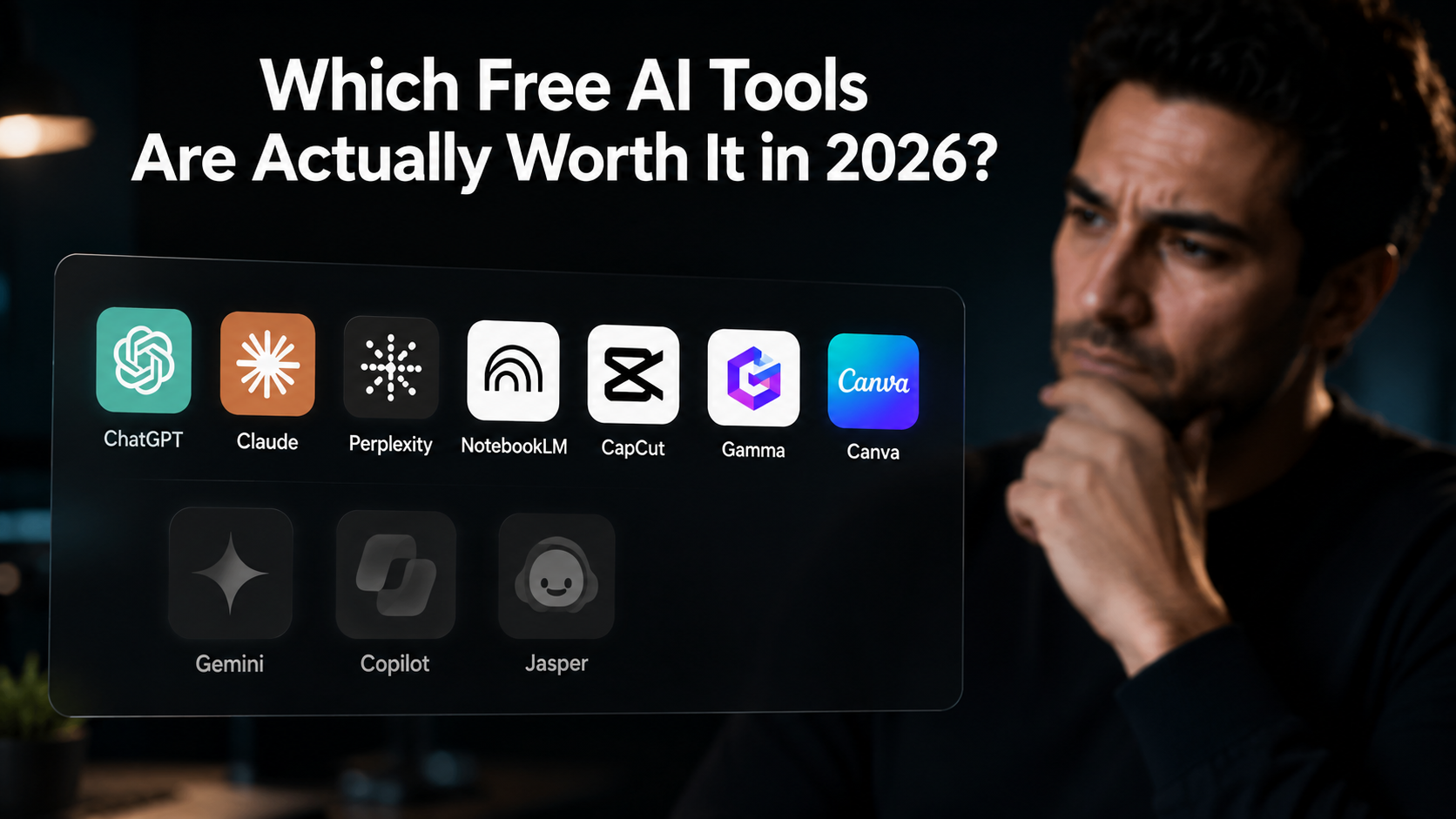
Free AI tools 2026 — that phrase appears in hundreds of listicles, roundups, and YouTube thumbnails right now. Most of them are recommending free trials with extra steps: five generations, ten messages, or a watermarked export that makes the output unusable for anything professional.
This list is different. Every tool here has a permanent, functional free tier that does real work without requiring a credit card or punishing you for using the product. The limits are stated honestly. Where a free plan is genuinely constrained, that is noted — because knowing where a tool stops working for you is as useful as knowing where it starts.
The focus is on tools relevant to software professionals, project managers, content creators, and anyone building a productive AI stack without a $300/month subscription budget. If you want a framework for deciding when a free tool is worth upgrading to paid, see how to evaluate AI tools without falling for the hype.
Table of Contents
- ChatGPT — General-Purpose AI Assistant
- Claude — Writing, Analysis, and Long Documents
- Perplexity AI — Research and Cited Answers
- NotebookLM — Source-Grounded Research
- CapCut — AI-Powered Video Editing
- Gamma — AI Presentation Builder
- Canva — AI Design and Visual Content
- Side-by-Side Comparison
- How to Build a Free AI Stack That Actually Works
1. ChatGPT — Top Pick Among Free AI Tools 2026
ChatGPT’s free tier in 2026 runs on GPT-5.5 Instant — OpenAI’s current entry-level model after retiring GPT-4o in February 2026. Free users get basic web browsing, file and image uploads, and access to the GPT Store. The soft cap sits around 30 chat turns per hour under fair-use limits, and image generation is available at roughly 2–3 DALL-E generations per day.
What it is good for: Drafting, editing, brainstorming, summarizing documents, writing code snippets, explaining concepts, and quick Q&A where a cited source is not required.
What the free plan does not cover: Extended thinking, deep research mode, and unlimited image generation are all behind the Plus or Pro paywall. The free model is capable but noticeably less thorough on complex multi-step reasoning tasks compared to paid tiers.
Best use case for beginners: First AI tool to add to your workflow. Broad enough to handle most starter use cases without needing to switch tools.
2. Claude — Writing, Analysis, and Long Documents
Claude is one of the strongest free AI tools 2026 has to offer for document-heavy work. The free tier includes Claude Sonnet 4.7, a 200K token context window, memory across conversations, web search, and basic tool use. The session-based usage limit resets every five hours. It does not include Claude Code or custom MCP connectors, which require a paid plan.
What it is good for: Long document analysis, structured writing tasks, rewriting and editing, synthesizing information from large inputs, and nuanced reasoning where tone and precision matter. The 200K context window on the free tier is a meaningful advantage — it lets you paste an entire report, contract, or codebase and work with it directly.
What the free plan does not cover: The May 2026 rate limit increases that doubled capacity for paid subscribers did not apply to free accounts. Heavy daily users will hit the session cap.
Best use case for beginners: Document-heavy work. If your day involves reading, summarizing, drafting, or editing long-form content, Claude free handles this better than most paid alternatives on ChatGPT’s lower tiers.
3. Perplexity AI — Research and Cited Answers
Perplexity is the research-focused entry in this list of free AI tools 2026. Its free plan gives you unlimited basic searches, 3 Pro Searches per day, 5 Deep Research queries per day, and limited file uploads (40MB per file, 30-day retention). It uses the Sonar model on auto-select — no access to GPT-5.2, Claude 4.5, or Gemini 3 Pro, which are Pro-only.
What it is good for: Fact-checking with citations, quick market research, comparing products or concepts, and answering questions where you need to know where the information came from. Unlike a standard chatbot, Perplexity returns sources with every answer, making it significantly more useful for professional research tasks where accuracy needs to be verifiable.
What the free plan does not cover: The 3 Pro Searches per day cap is a real constraint for anyone using it as a primary research tool. Deep Research at 5 queries per day is more workable for occasional use.
Best use case for beginners: Replace your standard Google search for research-heavy questions. Use it when you need a summary with sources, not just a list of links.
4. NotebookLM — Source-Grounded Research
NotebookLM is one of the most underused free AI tools 2026 has available. Google’s source-grounded research tool offers a genuinely generous free tier: 100 notebooks, 50 sources per notebook, 50 daily chats, and 3 Audio Overview generations per day — no trial period, no credit card, available to any Google account holder.
What it is good for: Upload your own documents — PDFs, Google Docs, YouTube links, website URLs — and NotebookLM builds a grounded AI that only answers from those sources. It will not hallucinate information from outside your uploaded materials. This makes it unusually reliable for research tasks where accuracy is non-negotiable. The Audio Overview feature converts your notebook into a conversational podcast-style summary, useful for processing dense material quickly.
What the free plan does not cover: Response customization (tone, length, style adjustments) is locked behind the Plus plan. The 50-query daily limit is sufficient for most individual use cases but constrains high-volume research sessions.
Best use case for beginners: Upload a product spec, a contract, a competitor’s documentation, or a research paper. Ask questions about it. Get answers that cite exactly where in your documents the information came from.
5. CapCut — Best Free AI Tools 2026 Pick for Video Creators
CapCut’s free tier in 2026 includes AI Auto-Captions with 100+ language support, AI Auto-Edit, text-to-speech, AI avatars, script-to-video, and exports up to 4K without a watermark on the desktop version. Caption accuracy for clear English audio sits around 92–95%. These are not stripped-down preview features — they are the core product, available without payment.
What it is good for: Short-form video creation for social media, educational content, and marketing. If you are producing content for YouTube Shorts, Instagram Reels, or TikTok, CapCut free handles the full production pipeline: recording, editing, captioning, and export. The AI Auto-Edit feature analyzes your footage and suggests cuts based on pacing, rhythm, and platform optimization.
What the free plan does not cover: Some premium templates and advanced AI generation features require CapCut Pro. Check commercial rights terms before using AI-generated elements in paid work.
Best use case for beginners: Any professional who needs to produce short-form video without hiring an editor. Drop your raw footage, enable Auto-Captions and Auto-Edit, adjust, export.
6. Gamma — AI Presentation Builder
Gamma belongs on any honest list of free AI tools 2026 because it solves a specific, recurring problem — the blank presentation deck — without charging you to do it. Its free plan gives you 400 lifetime AI generation credits, enough for roughly 10 full presentations. Export to PDF, PowerPoint, PNG, and Google Slides is included. The main limitation is a “Made with Gamma” watermark on exports, which disappears on the Plus plan at $10/month.
What it is good for: Building presentation decks without spending time on layout. Describe the content or paste a document, and Gamma’s AI Agent extracts the structure, organizes the slides, and applies formatting automatically. The output does not look like a default PowerPoint template. For PMs presenting proposals, developers demoing features, or anyone who needs a polished deck fast, Gamma is the most practical option in this category.
What the free plan does not cover: The 400 lifetime credit cap is the main constraint. Heavy users who regenerate slides frequently will exhaust credits in 30–40 decks on average. Once spent, you cannot generate new AI content without upgrading.
Best use case for beginners: Replace the blank PowerPoint problem. Use it when you need a structured, visually clean presentation quickly and do not want to spend two hours on slide layout.
7. Canva — AI Design and Visual Content
Canva rounds out this breakdown of free AI tools 2026 with the broadest visual content offering available at no cost. Its free tier includes 50 Magic Studio uses per month: Magic Design (10 generations/month), Dream Lab image generation (5 generations/month), Magic Write for AI-assisted copywriting, background remover, and basic chart creation. The free plan also includes 5GB of storage and access to Canva’s full core template library.
What it is good for: Social media graphics, thumbnails, branded documents, presentations, short video content, and visual output that needs to look professional without requiring design skills. Canva’s AI features in 2026 are tightly integrated into the editor, so you can generate, edit, and refine visuals inside the same workflow without switching tools.
What the free plan does not cover: Brand Kit, unlimited Magic Studio generations, Magic Resize, and priority access to new features are all behind the Pro paywall at $15/month. The 50 Magic Studio uses per month is workable for occasional use but constrains anyone producing visual content at volume.
Best use case for beginners: Visual content production for social media or internal documents. If you do not have a designer on your team and need professional-looking output, Canva free covers most of that gap.
Free AI Tools 2026: Side-by-Side Comparison
| Tool | Primary Use | Free Tier Limit | Best For |
|---|---|---|---|
| ChatGPT | General AI assistant | ~30 chat turns/hour, 2–3 image gen/day | All-purpose starter tool |
| Claude | Writing, long documents | Session cap, resets every 5 hrs | Document-heavy work |
| Perplexity AI | Cited research | 3 Pro Searches/day, 5 Deep Research/day | Fact-checking, quick research |
| NotebookLM | Source-grounded Q&A | 50 queries/day, 3 Audio Overviews/day | Analyzing your own documents |
| CapCut | Short-form video | 4K export, no watermark on desktop | Social video production |
| Gamma | AI presentations | 400 lifetime credits (~10 full decks) | Fast deck creation |
| Canva | AI design | 50 Magic Studio uses/month | Social graphics, documents |
How to Build a Free AI Stack That Actually Works
The mistake most people make when exploring free AI tools 2026 is trying to use one tool for everything. A more practical approach is to assign tools by task type:
- Drafting and writing: Claude or ChatGPT
- Research that needs sources: Perplexity for quick lookups, NotebookLM for your own documents
- Presentations: Gamma for AI-built decks, Canva for branded slides
- Video content: CapCut for short-form production
- Visual assets: Canva for social media and documents
None of these tools require a subscription to deliver real value. The combined free tiers cover a full professional content and productivity workflow. What they do not cover is high-volume daily usage — which is the natural upgrade trigger for each platform.
If you are evaluating whether any of these free AI tools 2026 options are worth upgrading, the right test is simple: use the free tier until it becomes the actual bottleneck in your workflow — not just an inconvenience. That is when the upgrade conversation makes sense. For a deeper framework, see how to evaluate AI tools without falling for marketing hype.
The Practical Next Step
Pick one tool from this list that matches the biggest time sink in your current workflow. Use the free tier for two weeks on real tasks, then evaluate whether it moves the needle. Starting with all seven at once is the fastest way to get overwhelmed and end up using none of them.
The tools that survive two weeks of real use are the ones worth thinking about upgrading. The rest can wait.
External References